- Why 11Sight?
- Our Solutions
- AI Agent
- Resources
- Company
- Partner Solutions
.png)
How Voice AI Gets Smarter Over Time: The Flywheel Explained
Picture a similar call coming in twice. On Monday, a customer asks about a safety recall on their car. Your agent handles it fine. A few days later, another customer asks the same thing. This time the agent handles it better, because the first call taught it how. That gap is the whole game. One agent answers the same way forever. The other sharpens with every conversation.
The 11Sight ecosystem closes that gap, and a flywheel drives it. Every conversation feeds a loop that makes the next one better. The agents already resolve 76% of inbound calls on their own. The other 24% go to a live person who has the full context. But the number is not the point. What matters is the machinery behind it. New agents are not built one prompt at a time. They drop into a system that already runs. Skills come from a shared library. Each agent is tested before it goes live. Every call is reviewed and fed into the next build.
That is the difference between buying an AI tool and running an AI workforce. A tool is frozen the day you buy it. A flywheel gains speed the longer it turns. Dealerships are the example here, but the logic fits any operation with more calls than people to answer them.
What Is a Voice AI Flywheel?
A flywheel is a heavy wheel. The first push is hard. The next is easier, because it is already moving. In customer operations, the pushes are conversations. The agent that answers the phone is the product. Behind it sits the system that builds, tests, deploys, reviews, and refines every agent. The flywheel is the engine that keeps that system turning. At 11Sight, engineers and the customer's own experts design each agent together. From there, the flywheel makes that agent, and every agent after it, sharper over time.
Most phone systems have no flywheel at all. An old phone menu answers its millionth call exactly like its first. It never notices callers pressing zero for a human. It never learns that one question always ends in a hang-up. A flywheel turns that call volume into something that builds, instead of a cost that repeats.
How the Flywheel Closes the Loop
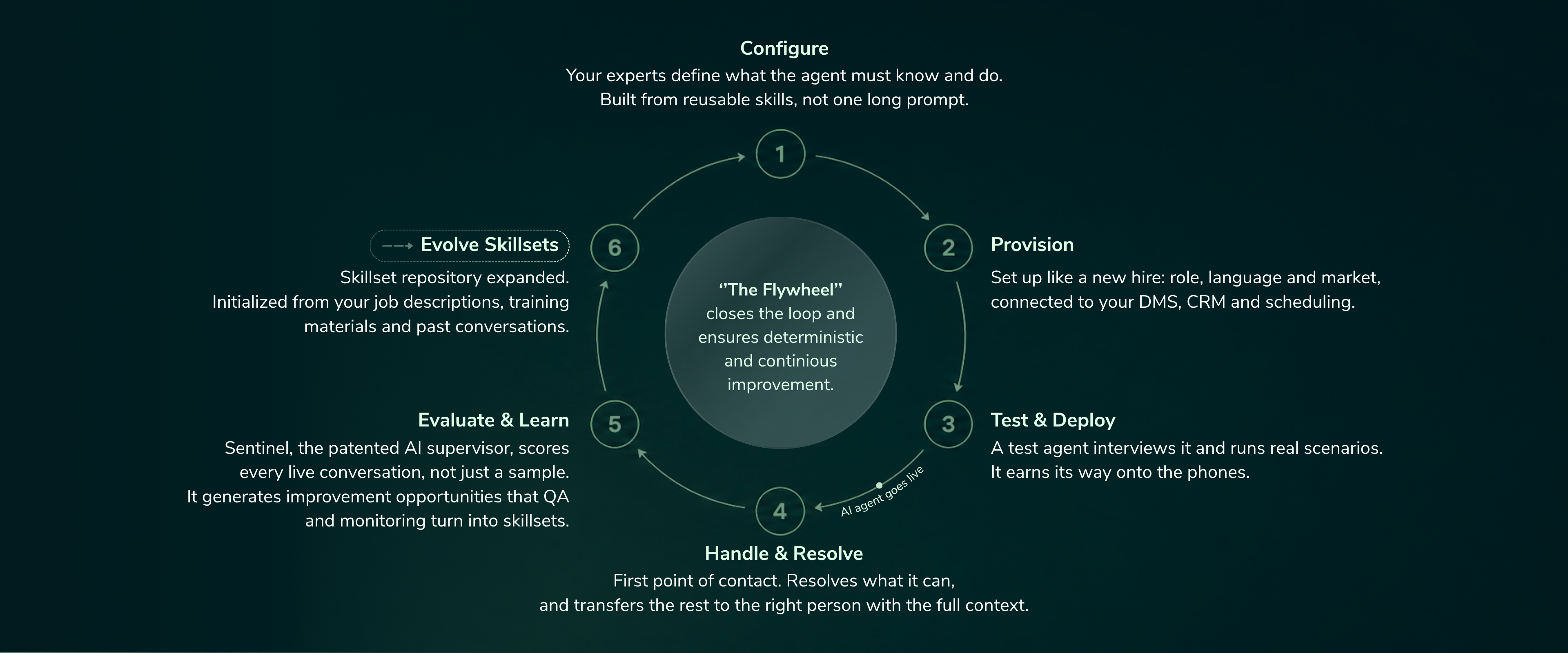
The flywheel runs one continuous loop. Each stage feeds the next:
- Assemble: Engineers and the customer's experts define what the agent should know and do. They build it from reusable skills, not one long prompt.
- Provision and localize: The agent is set up like a new hire. It is configured for its role, adapted to its language and market, and connected to the tools it needs.
- Test, then deploy: Separate test agents run practice calls and real scenarios before the agent takes a live call. It earns its spot on the phones.
- Handle: The agent takes first contact and resolves what it can. Anything it cannot, it passes to a live person with the full conversation.
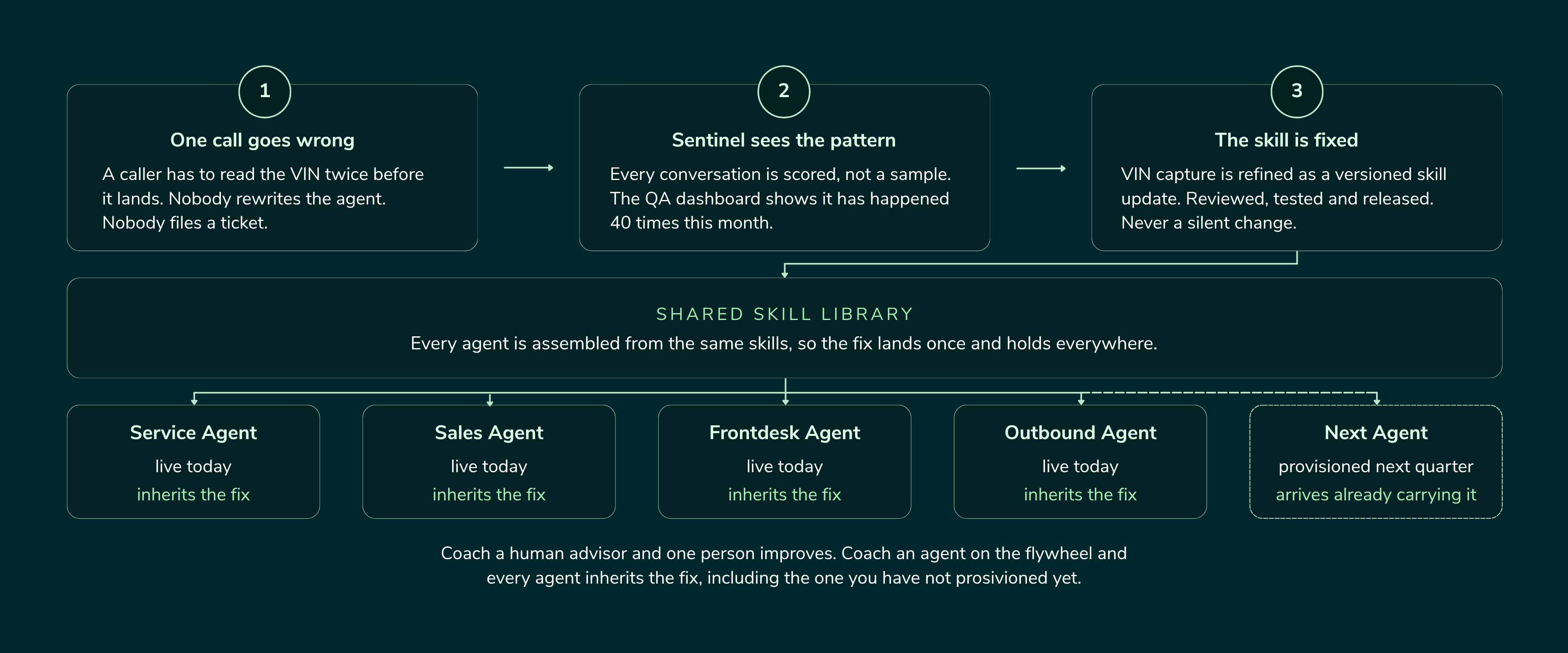
- Evaluate: Every call is scored against clear criteria, not just a sample. The Sentinel Agent catches failures and spots patterns humans would miss at volume.
- Learn and evolve: Dashboards turn those patterns into specific skill updates. The next caller reaches a stronger agent than the last one did.
Then the loop closes. What one agent learns on a call becomes a skill update every agent inherits. That includes the one on your phones today and the one you add next quarter. Nothing is learned twice, so each turn of the wheel takes less effort than the last.
Why Provisioning Beats Building From Scratch
The expensive part of voice AI was never the agent. It is the orchestration, the integrations, the testing, and the dashboards underneath. That machinery is built once. It is already running before you arrive. So your first agent is a project. Your second is a job description. Most customers start with the Service Agent, because the service line carries the most volume and the most measurable losses. Once it is live, adding a Frontdesk, Sales or Outbound agent just means naming the role. A team starting from zero has to build the whole foundation first, before its first agent can improve at all.
Why the Flywheel Depends on Structure, Not Prompt Hacking
A flywheel only pays off on a stable base. The shaky alternative is prompt hacking: rewording what you feed a general model and hoping it behaves. Structure gives you two checkpoints a quick build never has. Every agent is tested before it goes live. Every live call is judged after. Skip both, and the agent that nailed the demo drifts in production with nothing watching. Gains stick when every change is tested and measured, not guessed at. That is the subject of the next post in this series.
What the Flywheel Produces Over Time
The longer your agents run, the more they resolve on their own. The repeat question and the routine handoff stop reaching a person. Your team moves to the cases that actually need a human. That is the real payoff. Not just more calls handled, but fewer calls that need a person at all, with no drop in the context or quality your customers expect.
Bottom Line
An AI voice agent that never improves is just an expensive phone menu. The value is the loop around it. The flywheel assembles agents, tests them, runs them, scores every call, and turns what it learns into better agents. Plug a new agent in and it compounds from day one. That is the case for a workforce you grow over a tool you install.
Frequently Asked Questions
Does AI voice agent software actually improve over time?
It depends on the architecture. A scripted menu never will. A flywheel that scores every call and feeds the findings back into its agents will, month after month. The gains come from the loop, not the model alone.
How many calls can an AI voice agent handle on its own?
There is no ceiling on volume. The agents field unlimited calls at once. They resolve 76% on their own and route the other 24% to a person with full context.
What does it take to add a new AI agent?
You provision one into the existing flywheel by setting a few parameters and naming its tasks. It inherits the testing, monitoring, and learning loop from its first call. That is why it becomes productive almost immediately.
We already use another AI voice platform like Toma or Pam. Does switching mean starting from scratch?
They transfer to the right human team member with the full conversation and the goal of the call ready on screen. Those transfers get evaluated too, and they are often where the next skill update comes from.
We already run Toma or Pam. Does switching mean starting the wheel from a standstill?
No, and that is the part people expect to be painful. You are not starting a wheel from a standstill, you are stepping onto one that is already turning. The orchestration, the integrations, the test harness and the monitoring layer are all in place before your first call, and your agent is assembled from a skill library that every evaluated conversation before it has already refined. So the switch is a provisioning job, usually inside a week, rather than an implementation project, and the agent that picks up your phones on day one is not a beginner. If you are still weighing it up, start with Numa vs Toma vs 11Sight.
Want to see the loop in action, how an agent gets built, tested, and improved? Try a live demo at 11sight.com