- Why 11Sight?
- Our Solutions
- AI Agent
- Resources
- Company
- Partner Solutions
30 Years of Building: What Our CEO Aleks Gollu Shared on the STAK Ventures Podcast
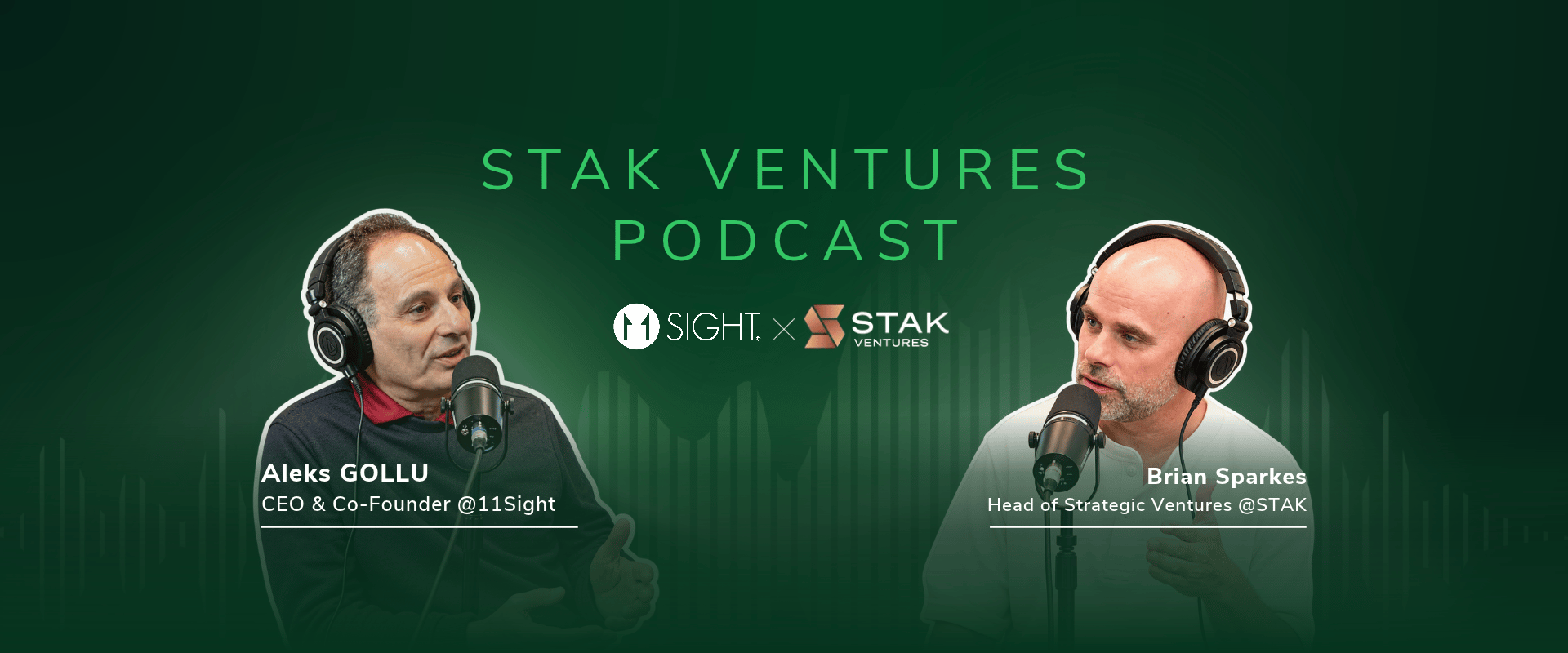
Our CEO, Dr. Aleks Gollu, joined the STAK Ventures Podcast for an in-depth conversation about what he learned from 30 years of building companies.
From his early days as a PhD student at Berkeley to founding three technology companies, teaching entrepreneurship at Northeastern University, and building 11Sight, Aleks shared frameworks and lessons that apply to anyone navigating the complexity of building something new.
The conversation was hosted by Brian Sparkes, Head of Strategic Ventures and Activation at STAK Ventures and CEO of Silicon Valley Venture LLC, on the STAK Ventures Podcast. Brian brings together founders, investors, and innovators at the intersection of capital, content, and community in the Bay Area.
Here Is What Stood Out
The Three Pillars of Innovation
When asked what he teaches aspiring entrepreneurs, Aleks did not start with product or market. He started with people.
He Breaks Effective Innovation Down Into Three Buckets
The first is character. The personality traits that make someone capable of operating under uncertainty. Resilience, risk tolerance, the ability to take things apart and put them back together. “If you are not comfortable operating in a fog,” he says, “maybe you can take a job at Google and still have a very successful career.”
The second is behavior. The practices that reinforce character. This includes asking three foundational questions before building anything: What do you want to achieve? What compromises are you willing to make? And do you have a winning strategy to get there?
The third is process. Design thinking, lean methodology, agile frameworks. The systems that translate character and behavior into actual products.
Most founders focus on the third. The best ones have all three.
Co-Founders: Friction Is the Point
Aleks has worked with the same co-founder, Farokh Eskafi, across multiple ventures over three decades. When asked why that relationship works, his answer was direct.
“You don’t want somebody who is an identical copy of you as your co-founder. You want to have the disagreements. But there needs to be trust and the ability to attack the problem, never each other.”
That culture of productive friction has to extend to the entire company. Diverse backgrounds and different skill sets create the tension that produces better solutions. The key is keeping the disagreement focused on the problem, not the person holding an opposing view.
From Commando to Civilization
One of the most useful frameworks Aleks shared describes how startups need to evolve as they grow.
Early stage, a startup operates like a commando unit. Everyone does everything. It is messy, fast, and chaotic. That chaos is not a problem. It is appropriate for the stage.
As the company grows, it transitions to something more like a military structure. Specialization emerges. Marketing, engineering, and operations develop their own lanes.
If the company reaches scale, it becomes what Aleks calls a “civilized bureaucracy.” Things slow down. Backward compatibility matters. The people who thrived in commando mode may not be the right fit anymore.
Knowing when to transition leadership is not failure, it is the job! In his second company, Aleks stepped back from the CEO role when the company needed a different kind of leader, moved to the board, and used that transition to start working on what would eventually become 11Sight.
Pivoting Requires Alignment, Not Just Courage
When the .com boom was distorting salaries and forcing his first company to rethink its direction, Aleks did not just pivot. He had to bring the whole team with him.
“Pivoting requires alignment. You need to win over your team.”
Not everyone arrives at the same conclusion at the same time. Forcing the issue or attacking people who are slower to see the need for change makes things worse. The same principle applies every time a company changes direction.
The lesson: pivoting is not just a strategic decision. It is a communication and leadership challenge first.
What Angel Investing Actually Looks Like
As an angel investor, Aleks has a clear-eyed view of the math. Write ten checks. Eight fail. One does mediocre. One returns 20x. That is the model.
But unlike institutional VCs who have the resources to run full due diligence, angel investors often have to make gut calls with limited information.
Aleks’s approach: he only invests in founders he has watched operate for six to nine months, or in his own companies. “It is a relationship game,” he says. Pattern recognition built over time matters more than a 15-minute pitch.
His advice for founders approaching angel investors: find out early whether anyone in the room actually understands your space. If you explain your market and hear crickets, you may be pitching to the wrong room.
Building for Scale, Not Just for Launch
When the conversation turned to conversational AI and what makes 11Sight different, Aleks made a point that applies well beyond voice agents.
“Going live is only the beginning. Whatever you build needs to continue operating for the next 10 years.”
The challenge is not building something that works for one customer. It is building something that can serve a million customers with a million different needs without fracturing into a million different products.
“A lot of investors make this mistake. They are so excited that the agent is working, they make the call: Let’s go live! Next thing they know they have 50 customers using your voice AI agents and they have 50 different voice AI agents.”
One product, deterministically configurable, backward compatible, able to evolve without breaking. That is the standard 11Sight was built around. And it is a standard that has not changed just because AI made it easier to build something quickly.
The Meaning Underneath It All
At the end of the conversation, Aleks was asked what he still loves about building companies after 30 years.
His answer was simple.
“Finding a challenge that is very difficult and yet attainable, and actually being able to deliver on it and create value.”
He was deliberate about the word value. Not revenue. Not exits. Value! The kind that sometimes is not quantifiable, but is what keeps you going when the financial losses make your stomach turn.
That is the thread running through three decades of building, teaching, and investing. Not a single piece of advice that guarantees success, but a commitment to solving hard problems and creating something that was not there before.
You can watch the full conversation on the STAK Ventures Podcast: Episode 8, Navigating Startup Chaos With Aleks Gollu